

Registration is closed for Teacher Talks 2026

Dr. Oanh Duong Thi Hoang, Associate Professor and Senior Lecturer, School of Communication and Design at RMIT Vietnam
Translanguaging in Vietnamese EMI University Classroom Discourse: Research & Practical Applications
Presenter Bio Dr. Dương Thị Hoàng-Oanh (PhD, 2004) is a Senior Lecturer and Researcher at RMIT Vietnam. With 40 years of experience in teaching, research, curriculum development, professional translation and interpreting, she has made substantial contributions to education and applied linguistics through her publications, research, and professional service. Her academic work has been supported by prestigious scholarships and fellowships from the Australian government (1989, 1994), the New Zealand government (2000–2004), the Endeavour Postdoctoral Scheme (2014, 2010), and Fulbright fellowships (2006–2007). She served as a Vietnam country representative to Asia TEFL from 2015 to 2021 and won an RMIT Vietnam Excellence in Learning and Teaching Award in 2025.
Session Abstract Translanguaging is increasingly recognized as a valuable resource for learning and participation in English-medium instruction (EMI) classrooms. However, research has often examined translanguaging functions in isolation, overlooking the contextual factors that shape their use in classroom interactions. This interactive workshop therefore presents findings from a study of Vietnamese university students’ translanguaging practices in EMI classrooms. Classroom discourse data reveal that students engage in translanguaging for three broad purposes: academic, management, and interpersonal. Beyond presenting the research, the workshop will engage participants in analysing authentic classroom excerpts, identifying translanguaging functions, and exploring how multilingual resources can be strategically leveraged to support comprehension, collaboration, and engagement. Participants will learn about practical pedagogical translanguaging activities, including bilingual brainstorming, multilingual peer discussion, translanguaging scaffolds for complex concepts, and reflective task design for EMI contexts.

May Barbree, Academic Manager, Learning & Teaching, SEUP at RMIT Vietnam
From English Language Teaching to English-Medium Instruction in Vietnam
Presenter Bio May Barbree is the Academic Manager, Learning & Teaching in the School of English & University Pathways at RMIT University Vietnam. She holds a Master of Education and is Cambridge DELTA qualified. With more than 15 years’ experience in English language teaching, teacher development, and academic management, she has worked across university and language education contexts in four countries. Her current work focuses on professional learning, teacher training strategy, and building sustainable models for practice-based scholarship. She is particularly interested in how teacher professional learning can support quality enhancement, institutional capability, and sector engagement in ELT and EMI contexts.
Session Abstract As Vietnam moves from an EFL orientation toward wider use of ESL and English-medium instruction, English language teaching professionals have an important role to play beyond preparing students and lecturers for language readiness. This practice-oriented presentation examines how established expertise in ELT can contribute to English-medium instruction through pedagogy, curriculum support, classroom communication, and language-aware assessment. The session begins by clarifying English-medium instruction as the teaching and assessment of subject-specific content in English, while noting that definitions vary across contexts and institutions. It then considers the implications of recent national direction in Vietnam, where English is increasingly positioned as a working language in education rather than only a subject of study. Drawing on practical examples from language teaching, the presentation identifies transferable areas of ELT expertise, including but not limited to: communicative teaching approach techniques, collaborative learning, differentiation, and questioning techniques. Participants will be invited to reflect on how these practices can support subject teachers, students, and curriculum teams in English-medium environments. The presentation argues that English-medium instruction does not make English language teachers less relevant; instead, it makes their pedagogical knowledge more strategically important. .

Y Nhu Nguyen, Teacher, Star Education
Reflective Technology Integration for Teacher Agency and Learner Engagement
Presenter Bio Nguyễn Ý Như, M.S.Ed., is an English teacher at Star Education in Ho Chi Minh City. She holds a Master of Science in Education in TESOL and Applied Linguistics and a Bachelor of Arts from Vietnam National University. With nine years of teaching experience, she has worked with Vietnamese and international learners across diverse proficiency levels. Her previous experience includes academic support at RMIT University Vietnam and English language teaching at ILA Vietnam. She has presented at national and international ELT conferences. Her interests include technology-enhanced language learning, learner engagement, assessment, teacher development, and innovative TESOL pedagogy.
Session Abstract This interactive workshop introduces a reflective framework for technology-enhanced English language teaching that strengthens teacher agency and learner engagement. Participants will examine short classroom scenarios, identify mismatches between digital tools and learning objectives, and redesign one technology-supported activity using before-, during-, and after-lesson reflection prompts. Through guided demonstrations and hands-on practice with selected platforms, participants will explore practical applications for formative assessment, differentiated participation, collaborative learning, vocabulary development, and learner feedback in mixed-proficiency classrooms. The workshop will also highlight how teachers can use real-time evidence of learning to make informed instructional decisions rather than using technology only for entertainment. By the end of the session, participants will take away a reusable reflection checklist, an adaptable activity-planning template, and practical strategies for selecting, evaluating, and refining digital tools to support sustainable classroom practice and professional development. .

Chi Nguyen, Managing Director – Founder, Le Kien Thuc Viet English School - English With Mr. Bryan
The 10-Minute Loop: Asynchronous Peer Coaching for Sustainable Professional Learning
Presenter Bio Nguyen Chi Le is an English language educator, founder, and centre manager based in Bien Hoa. His teaching experience spans speaking and writing development as well as engaging, age-appropriate approaches for primary learners. He is particularly interested in innovative pedagogies such as Communicative Language Teaching and Task-Based Learning, and in adapting established frameworks to contemporary classroom needs. His recent work has explored rethinking Bloom’s Taxonomy, including an interactive Action Lab presented at VietTESOL International 2026.
Session Abstract In the rapid pivot to ESL from EFL, observations, despite being a powerful quality assurance tool, often become a high-stress, low-frequency administrative bottleneck. Sustainable professional development therefore requires continuous, low-stakes collaboration rather than isolated, high-pressure evaluation. The workshop introduces the ’10-Minute Loop’, a simple, asynchronous peer coaching model designed to support development without disrupting daily operations or increasing teacher burnout. The workshop offers an alternative perspective to lengthy workshops or stressful evaluations; that PL requires a structured, efficient system. Through brief, focused peer dialogue, educators can reduce professional isolation and build sustainable, low-stress support through regular, manageable exchanges between colleagues. Using simulated micro-video and targeted feedback protocols, participants will experience an asynchronous loop and practice delivering concise, criteria-specific feedback, leaving with a practical toolkit for developing a self-sustaining, psychologically safe professional learning culture closely connected to the realities of the modern ESL classroom.

Loralee Simonitch, SEUP at RMIT, Senior Educator
Turning Classroom Questions into Action Research
Presenter Bio Loralee Simonitch is a Professional Learning Specialist and Senior Educator in the School of English and University Pathways at RMIT University in Vietnam. She holds a Master’s degree in TESOL and is CELTA-qualified. With 13 years of experience in English language teaching and teacher development, she has worked across language centres and university contexts in four countries. Her current work focuses on professional learning and programme design, particularly on sustainable professional learning initiatives. She is particularly interested in teacher and learner autonomy, engagement, and how practice-based professional learning can improve student outcomes. Her work emphasises scalable, context-responsive approaches to teacher development.
Session Abstract Teachers encounter questions, challenges, and opportunities for growth throughout their careers. These moments often provide the starting point for meaningful professional inquiry and classroom improvement. This interactive workshop introduces a practical framework for transforming everyday teaching questions into focused action research and professional learning projects. Participants will work through a step-by-step process for identifying an area of inquiry, crafting a clear problem statement, and developing research questions that can guide meaningful classroom-based investigation. Through guided activities and discussion, attendees will apply each stage of the process to their own teaching context and begin outlining a project they can continue beyond the workshop. The session will also introduce a set of AI prompts designed to support question refinement, planning, reflection, and project development. Participants will leave with a draft action research project and practical tools for sustaining evidence-informed professional learning.

Uyen Tran, Head of Academics, YOLA Educational Institution
The 3–3 AI-Bloom Framework: Transforming AI Outputs into Higher-Order Thinking
Presenter Bio Tran Mai Uyen is the Head of Academics at YOLA Educational Institute, where she oversees academic quality and supports the professional development of nearly 200 teachers. She holds an MA in Applied Linguistics and TESOL and previously lectured at International University and the University of Economics and Law, Vietnam National University, Ho Chi Minh City. With nearly a decade of experience in English language teaching, teacher training, curriculum development, and academic leadership, her professional interests include student-centred pedagogy, educational technology, activity-based learning, and AI-integrated learning design. Mai Uyen has presented at ELT conferences including ThaiTESOL, VietTESOL, VUS TESOL, and Mekong TESOL, sharing practical, research-informed approaches to classroom innovation.
Session Abstract "When AI can generate an answer in seconds, what should students still be learning? As generative AI reshapes education, teachers have an opportunity not to replace learning with technology, but to redesign learning for deeper thinking. This workshop introduces the *3–3 AI-Bloom Framework*, a practical approach to integrating AI with Bloom’s Taxonomy. AI supports *Remember, Understand, and Apply* through retrieval, explanations, guided practice, and immediate feedback. Teachers then build on this foundation through purposeful in-class activities that move students toward *Analyze, Evaluate, and Create*. Used purposefully, AI can free up valuable classroom time for richer discussion, stronger reasoning, and more meaningful creation. Participants will explore and experience strategies such as inquiry-based tasks, evidence-based discussions, collaborative problem-solving, decision-making, and project-based learning that challenge students to examine ideas, justify judgments, generate solutions, and create meaningful products. Participants will leave with a practical framework and classroom-ready ideas for deciding what AI should support—and where teachers can create space for higher-order thinking. "

Muhammad Jafarpour, English Teacher and Teacher Trainer, CB Centres
Reimagining Coursebook Tasks with AI for Meaningful Communication
Presenter Bio Muhammad Jafarpour Rezayee is an English language teacher and teacher trainer based in Vietnam, currently working at CB Centres. He holds an MA in ELT and a Cambridge CELTA qualification. With experience teaching learners across proficiency levels and training teachers in practical, classroom-oriented methodologies, his professional interests include communicative language teaching, materials adaptation, and the effective integration of AI into lesson design.
Session Abstract While AI has made lesson adaptation faster than ever, many teachers have yet to exploit its full potential for redesigning learning tasks. Many ELT coursebooks are developed for global audiences, often including decontextualized controlled practice activities. Therefore, teachers need to be equipped to critique tasks and redesign activities to serve clear communicative purposes. This workshop introduces a practical framework centered on contextualization, differentiation, and communicative purpose, enabling teachers to develop a future-ready approach to materials adaptation in which AI supports, rather than replaces, pedagogical decision-making. In this hands-on workshop, participants will use AI to transform controlled practice into meaningful communicative tasks. Participants will analyze the limitations of coursebooks, explore how to implement adaptation techniques, and finally apply the techniques using AI. Through guided demonstrations and collaborative redesign, participants will leave with a practical framework and redesign techniques they can immediately apply to their own coursebooks.

Xuan Khang Pham, Freelance EFL Teacher
Tech-Enabled Peer Assessment for Self-Regulated English-Medium Learning
Presenter Bio Pham Xuan Khang is an ELT educator and curriculum designer operating in the Vietnamese context. His pedagogical practice focuses on bridging the gap between traditional instruction and authentic communicative competence. He specialises in integrating Generative AI, Project-Based Learning (PBL), and Content and Language Integrated Learning (CLIL) to support diverse demographics, ranging from secondary EFL teenagers to adult software engineers in ESP settings. He is deeply passionate about shifting exam-centric paradigms towards future-ready, tech-enabled frameworks that foster self-regulated learner autonomy and empower fellow educators in modern English-medium environments.
Session Abstract This hands-on workshop introduces a future-ready pedagogical framework designed to overcome the cultural inhibition and cognitive overload that EFL teenagers frequently face during spontaneous interactive tasks. Participants will learn to implement a low-threat, Task-Based Language Teaching model utilizing a modified Tell-Ask-Give (TAG) peer-review method. During the session, educators will actively apply a "1-device negotiation" protocol, discovering how sharing a single smartphone encourages students to verbally negotiate peer scores and build authentic communicative competence. Finally, participants will learn to deploy a simple Google Apps Script architecture that automatically routes these submitted scores into individualized, visual progress dashboards. Attendees will leave equipped with a ready-to-use, tech-enabled assessment ecosystem that fosters self-regulated learning without causing administrative overload in their English-medium classrooms.

Matt Kelly, Academic English Manager, SEUP at RMIT Vietnam
Deciding Where Teaching Matters: Teaching in a Time of Change
Presenter Bio Matt Kelly is Academic English Manager for the English for University Program at SEUP, Saigon South Campus. With over 15 years’ teaching experience in England, Vietnam, and Japan, he has worked across pre-sessional courses, Teacher Training Departments, Language Centres, and publishing companies. At SEUP, he has also served as National Coordinator for the New Initiatives Department. His qualifications include CELTA, CELT-YL, Train the Trainer, and IDLTM. Matt is particularly interested in teacher development and approaches that empower learners, encourage reflection, and foster future-ready classrooms where students take an active role in their own learning.
Session Abstract Every new tool changes what is possible in the classroom—but it also changes the decisions teachers have to make. So what happens next? Together, we'll tackle that question through a series of collaborative design challenges, making decisions about teaching and learning, comparing different ways forward, and redesigning familiar lessons. Working in small groups, we'll analyse classroom scenarios, build learning journeys, and test ideas with colleagues before applying them to lesson redesign. As we do, we'll question some of the assumptions that shape everyday teaching and ask what belongs in the classroom when so much can happen beyond it. You'll leave with practical ideas for lesson design, fresh perspectives on the decisions teachers make every day and, hopefully, a few new questions to take back to your own classroom.

Leslie Crudup, Educator, SEUP at RMIT Vietnam
More Than Learners: Recognizing Student Strengths in the Language Classroom
Presenter Bio Leslie Crudup is a language educator at RMIT and a mindset coach with a passion for personal empowerment. She holds a Master's Degree in Applied Linguistics and specialist training in Motivational Interviewing and coaching, and brings this expertise together with specialist experience in e-learning, training, and curriculum development. She has spent her career helping students and professionals build confidence and self-efficacy to reach their goals through strengths-based strategies grounded in how people actually learn and grow. She has worked with organisations across the USA, Europe, Asia, and Australia, bringing a global perspective to her teaching and support. She is on a mission to create learning environments where individuals are recognised not just for what they're learning, but for what they contribute to their classroom culture.
Session Abstract This interactive workshop will equip educators with practical strategies for using the VIA Character Strengths Survey to enhance student motivation. Grounded in principles of positive psychology, the VIA Survey enables learners to identify and apply their unique character strengths to their language development journey. Participants will learn how to integrate strengths-based approaches into lesson planning, classroom activities, and assessment to foster greater student engagement and self-efficacy. Through real classroom examples and hands-on activities, the workshop will demonstrate how strengths can be intentionally leveraged to support language tasks, increase participation, and personalize instruction. Attendees will receive adaptable materials designed to connect character strengths with key language outcomes. By the end of the session, educators will be prepared to create more empowering and inclusive learning environments that recognize students not only as language learners but as capable individuals with diverse strengths to contribute.
Tuan Phuoc (Peter) Pham, Teacher/Co-founder, PTE MAGIC
Beyond AI Feedback: Fostering Self-Regulated Learning through AI-Enhanced English Pedagogy
Bio coming soon . .
Session Abstract Abstract coming soon . .

Thao Nguyen, Educator, SEUP at RMIT Vietnam
Supporting Idea Generation and Organization Through Visual Scaffolding
Presenter Bio Thao Nguyen holds a master’s degree in TESOL and has more than 17 years of experience teaching across programs such as IELTS, SAT, and academic English. She is interested in practical classroom strategies that help learners develop critical thinking, foster a love of language learning, and create classrooms where students take an active role in their own learning. Her teaching focuses on scaffolding, designing learner-centred activities, and developing students’ communicative skills in English. She is also a language enthusiast who studies Japanese independently in her free time and actively participates in English and Japanese workshops and professional development courses to continually refine her teaching practice.
Session Abstract Many students struggle to generate and organize ideas for unfamiliar or abstract writing topics, even after being provided with reading materials and topic-specific vocabulary. While language support is essential, it does not always address the cognitive challenge of planning what to write. This workshop introduces a visual pre-writing scaffold, an approach that uses visual representations to help learners externalize their thinking and organize their ideas before drafting. By shifting the intial planning process from “thinking in words” to “thinking in visuals,” the approach allows learners to focus on generating and sequencing ideas before translating them into written texts. Participants will first experience this approach from a learner's perspective before exploring several classroom adaptations, including presentation planning, storyboarding, and image-based sequencing, and will leave with practical strategies they can immediately apply to support idea generation and organization in their own writing classrooms.
%20Truong.jpg)
Thu Trang (Janes) Truong, Co-founder / Teacher Trainer, The Community of ELT Practice
To Generate or To Educate? Designing Learning That Sticks
Presenter Bio Truong Thu Trang (Janes) is an English teacher educator, researcher, and co-founder of the Community of ELT Practice (CEP), one of Vietnam's largest professional learning communities for English teachers. She holds a Master of Education (TESOL) from Edith Cowan University, Australia, and has presented at national and international ELT conferences. Her professional interests include pronunciation pedagogy, teacher development, AI-supported learning design, and cognitive approaches to language teaching. Through practical workshops, she helps teachers transform research-informed ideas into engaging classroom practices that improve learner confidence and communication.
Session Abstract Teachers are using AI to create more classroom materials than ever before, but more content does not always lead to better learning. This workshop introduces a simple design approach that turns AI-generated content into activities students can notice, remember, and use. Participants will redesign AI-generated words and visuals with typography to highlight pronunciation, vocabulary, and meaning, then transform them into interactive games, movement-based activities, and speaking tasks. Along the way, we will discuss when AI saves time, when teachers need to step in, and how small design choices can improve attention and reduce unnecessary distraction. Every activity will be demonstrated, analysed, and adapted for different teaching contexts. Participants will leave with practical lesson ideas, an easy-to-use design process, and ready-to-apply strategies for making AI work as a teaching partner rather than simply a content generator.

Amir Esmaeili, Academic Manager and Team Lead for Foreign Teachers, CB Centres
Inclusive Practice Through Practical Differentiation Strategies
Presenter Bio Amir Esmaeili is a Delta-qualified teacher trainer, TKT tutor, and certified speaking examiner. He holds an MA in TEFL and has written articles for a range of professional publications. Over the past 15 years, he has presented at numerous international conferences and led educational organisations. His professional interests include teacher agency, inclusive practice, differentiation, and AI in ELT. He currently serves as Academic Manager and Team Lead for Foreign Teachers at CB Centres in Vietnam. Amir considers himself a lifelong learner, a dedicated educator, and a constant work in progress.
Session Abstract Every EFL classroom includes learners with varying proficiency levels, confidence, and learning preferences, underscoring the importance of inclusive practice through purposeful differentiation. Effective differentiation should respond to learner diversity without increasing teachers' workload. This workshop presents differentiation through a practical four-pillar framework—content, process, product, and learning environment—making each pillar immediately applicable to everyday teaching. Participants will experience four hands-on activities as learners before adapting them for their own classrooms. From content choice boards and tiered task scaffolds to strategic grouping techniques and flexible product options, each strategy is modelled, practised, examined, and adapted for authentic teaching contexts. By the end of the session, participants will have a clear understanding of the four pillars of differentiation and leave with practical strategies, adaptable lesson ideas, and a classroom-ready toolkit they can confidently implement in their very next lesson to ensure that no learner is left behind.

Han Ngo, Educator, SEUP at RMIT Vietnam
Getting past the Intermediate Plateau: Four Shifts for Future-Ready Pedagogy
Presenter Bio Han Ngo holds a Master of TESOL and is an English Educator at RMIT Vietnam’s School of English and University Pathways. With ten years of teaching experience and three years in teacher education, he is passionate about helping teachers translate research into practical classroom pedagogy. His professional interests include language development beyond the intermediate level, active learning, vocabulary acquisition, learner autonomy, and assessment. Han previously presented at Teacher Talks 2025, where he shared practical strategies for language teaching. In his workshops, he aims to equip teachers with research-informed, classroom-ready approaches that promote meaningful and sustained language development.
Session Abstract What if the intermediate plateau is not primarily a learner problem, but a pedagogy problem? Many learners remain at an intermediate level despite years of English study, yet classroom instruction often changes little once students move beyond the basics. This interactive workshop argues that helping learners progress requires teachers to rethink—not simply intensify—their instructional practices. Through classroom demonstrations, collaborative lesson redesign, and reflection, participants will explore four pedagogical shifts: from building accuracy to building expressive power, from practicing language to solving meaningful problems, from checking listening to mining it for language, and from teacher-controlled improvement to learner-driven growth. Grounded in second language acquisition research and illustrated with practical classroom examples, the workshop equips teachers with a coherent framework for redesigning lessons that better support sustained language development. Participants will leave with immediately adaptable strategies for helping intermediate learners continue moving forward.

John King, Senior Educator, SEUP at RMIT Vietnam
‘What's it about?’ Building global understanding in reading and listening
Presenter Bio John King (M.A. Linguistics and German) is a Senior Educator and Curriculum Specialist at RMIT University, where he has been teaching Academic English for over four years. Before that, he spent another six years teaching teenagers and young adults at different universities and IELTS preparation centres across Ho Chi Minh City. A fan of quiz shows and board games, John loves finding new ways to engage and challenge his learners and is always looking for new resources or tools to support the development of both language and critical thinking skills.
Session Abstract One of the greatest challenges in teaching receptive skills is knowing how much is being understood. Sometimes the simplest question can be the most difficult for learners to answer: ""So what was it about?"" Developing the ability to understand the overall message is essential for learners to engage more confidently and meaningfully with what they read and listen to, both inside and beyond university. In this interactive workshop, participants will have the opportunity to analyse a variety of gist activities designed to help learners see the bigger picture in different types of texts, from traditional summarising tasks to more creative visual approaches. Participants will also discuss the general strategies behind the activities, before considering how these can be applied to their own teaching contexts. With these new tools, participants will leave with better ways to understand what their learners understand!

Tuan Phuoc (Peter) Pham, Teacher/Co-founder, PTE MAGIC
Beyond AI Feedback: Fostering Self-Regulated Learning through AI-Enhanced English Pedagogy
Presenter Bio Peter Pham is Co-founder and CEO of MAGIC, an English language education organisation specialising in AI-enhanced language learning and assessment. With over a decade of experience in English language education, teacher development, and educational technology, he has worked with schools, universities, and language institutions across Australia and Vietnam. His professional interests include AI-enhanced pedagogy, learner autonomy, assessment, and the integration of technology to support meaningful language learning. Peter is passionate about helping educators harness AI to strengthen, rather than replace, effective teaching practices.
Session Abstract The rapid adoption of generative AI has significantly increased learners' access to immediate and personalised feedback. However, feedback alone does not necessarily promote meaningful learning. Without opportunities for reflection, goal-setting, and strategic revision, students may become dependent on AI-generated corrections rather than developing the self-regulatory processes required for long-term language development. Grounded in principles of Self-Regulated Learning (SRL), this workshop introduces a practical pedagogical framework that integrates AI-generated feedback into structured classroom learning cycles. Through interactive activities and classroom examples, participants will explore how teachers can guide learners to interpret feedback critically, monitor their own progress, and engage in deliberate practice while maintaining the teacher's central role as facilitator of learning. Rather than advocating for particular AI technologies, the workshop focuses on transferable instructional principles that can be adapted across diverse English language teaching contexts. Participants will leave with practical strategies and classroom-ready activities to foster learner autonomy, metacognitive engagement, and more purposeful use of AI in English language learning.
Ho Chi Minh City
Saturday, 10 October 2026
7:45-16:15
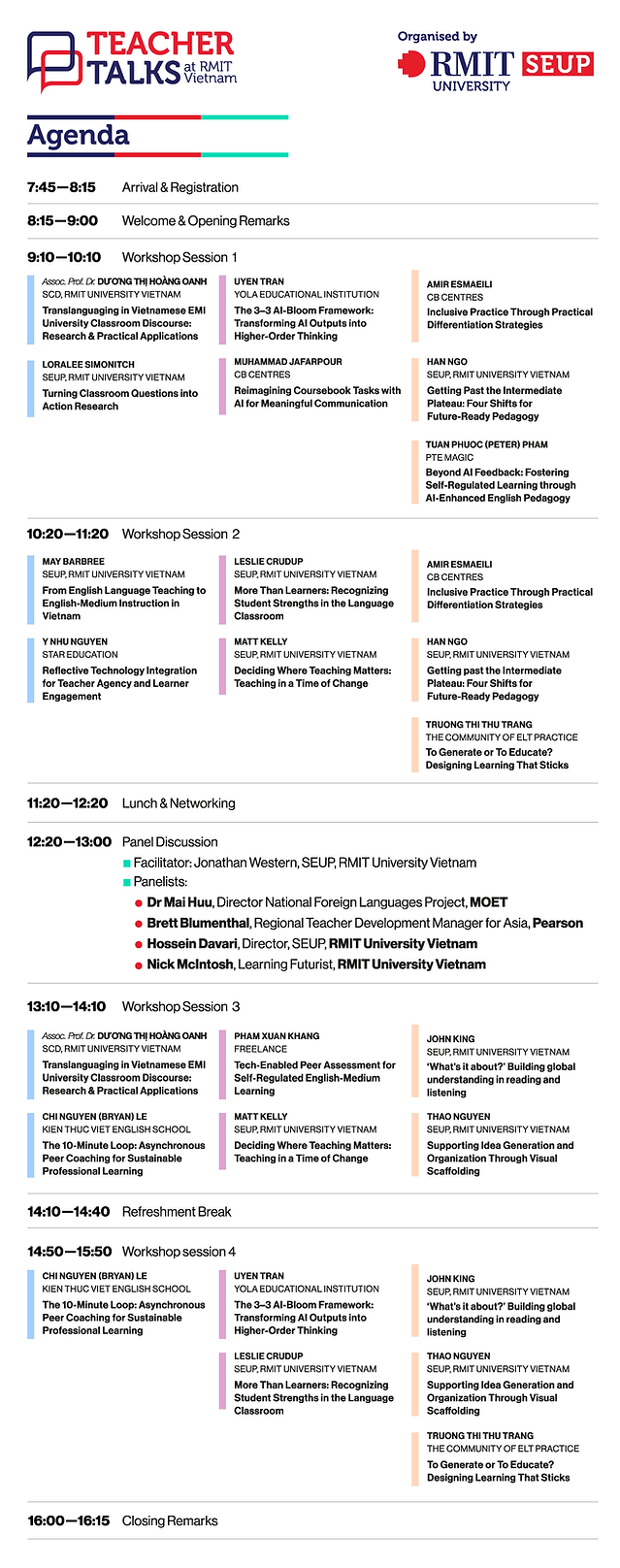
Teacher Talks Ho Chi Minh City is a full-day event with a broad program focused on AI-supported learning design, inclusive and differentiated teaching, assessment and self-regulated learning, translanguaging, action research, receptive and productive skills, and sustainable teacher development. Sessions combine emerging approaches with practical classroom strategies across ELT and EMI contexts.
Click the stream above to read more about the sessions and presenters.

Dr Nguyen Thi Mai Huu, MOET
Plenary Keynote
Nguyen Thi Mai Huu was assigned to be the director of the National Foreign Languages Project, Ministry of Education and Training of Vietnam in January 2017 and has been in her office since then. She has engaged in a wide range of national projects, professional conferences, education activities and has made contribution to the development of Vietnam’s national foreign languages education. Nguyen Thi Mai Huu delivered lectures and worked for years at Vietnam National University, where she gained knowledge base for teaching and research profession. She served as the Deputy Director of Language Testing and Assessment Center of the University of Languages and International Studies (Vietnam National University, Hanoi), where she was involved in the development of the Vietnam Standardized Test of English Proficiency (VSTEP), which is now a national test of Vietnam. Her research interest includes educational management, language test development and validation, test specifications, formative assessment, ESP, CLIL and EMI.

Hossein Davari, Director, School of English and University Pathways, RMIT Vietnam
Opening Remarks, Panelist
Hossein Davari is Director of the School of English and University Pathways (SEUP) at RMIT University Vietnam, where he provides strategic leadership for English language education, academic pathways, and transnational education initiatives. He has extensive experience across higher education pathways, English language teaching, quality assurance, and international education, having held senior academic and leadership roles in Australia and Vietnam. Hossein is an active contributor to the English language teaching and international education sectors. He currently serves on the Board of NEAS, the Australian quality assurance organisation for English language teaching, and previously served on the Board of English Australia, the peak body for the ELICOS sector in Australia. His professional interests include English as a Second Language (ESL) policy implementation, English-Medium Instruction (EMI), pathway education, quality assurance, and the integration of educational technology and AI to enhance student learning and success.

Nick McIntosh, Learning Futurist, RMIT Vietnam
Panelist
Nick McIntosh is a Learning Futurist at RMIT University Vietnam, where he and his team explore emerging edTech and the latest ideas in Higher Education Learning and Teaching – from Artificial Intelligence and Learning Analytics to next-generation learning spaces and extended realities. With over a decade of experience in HE at universities in Australia, China, the UK, and Vietnam, Nick brings a diverse and international perspective to his work. He has a proven track record of identifying, prototyping, and scaling innovative learning solutions, driving transformative institutional change while significantly increasing student engagement and achievement at scale. Nick's current focus is on leveraging AI, Learning Analytics, and AR/VR-based learning experiences to shape a more innovative, responsive, and human-centric future for HE learning and teaching.
.jpg)
Brett Blumenthal, Pearson
Panelist
Brett Blumenthal is a DELTA-qualified education consultant and Regional Teacher Development Manager at Pearson. With more than 20 years of teaching and leadership experience in Vietnam and the United States, he specializes in teacher training, curriculum design, and educational development. Brett has managed academic programs at leading institutions in Vietnam and delivered workshops and presentations across diverse educational contexts internationally. He is passionate about empowering educators and enhancing student outcomes through practical, research-informed teaching strategies. His current work focuses on supporting teachers across the region to create student-centered learning environments through evidence-informed teaching practice.

Jonny Western, Head of Program, School of English & University Pathways,
RMIT Vietnam
Panel Facilitator, Closing Remarks
Jonathan Western is the Head of Program, New Initiatives in the School of English & University Pathways at RMIT University Vietnam. He holds an MA in Educational Technology and has more than 15 years’ experience in English language teaching, academic leadership, and program development. His current work focuses on leading new academic initiatives through responsive program design, cross-functional collaboration, and quality enhancement. He is particularly interested in the pedagogically sound application of educational technology and AI, professional learning ecosystems, team development, and EMI sector engagement.

Dr. Dieter Bruhn, President and Vietnam Country Director, One World Training
AI for EMI: Making Complex Content More Accessible
Presenter Bio Dr. Dieter Bruhn is a dynamic educator, teacher trainer, and President of One World Training, bringing more than 30 years of international teaching and training experience. He holds a Doctor of Business Administration, a master’s degree in TESOL, and a master’s degree in Language and International Trade. He has worked with educators and institutions across Asia, Latin America, Africa, and the United States, designing engaging, practical learning experiences for diverse contexts. His professional interests include English-medium instruction, artificial intelligence in education, teacher development, intercultural competence, and innovative, student-centred approaches that turn ideas into meaningful classroom practice.
Session Abstract EMI teachers often need to make complex academic texts accessible without removing essential concepts or lowering cognitive demand. This interactive workshop demonstrates how generative AI can help educators adapt challenging materials for multilingual learners while preserving disciplinary accuracy, key terminology, and meaningful learning outcomes. Participants will first analyze a dense academic passage to identify linguistic barriers and concepts that must remain. Working in small groups, they will then use a practical prompting framework to create a more accessible version for a defined student level. Groups will evaluate the AI-generated text using criteria for accuracy, accessibility, rigor, vocabulary support, and student agency, then revise it accordingly. Finally, participants will design a short comprehension, discussion, or application task based on the adapted text. They will leave with a reusable prompt template, an evaluation checklist, and a practical process for simplifying the language of EMI materials without simplifying the learning in their classrooms. . .

Van Anh Cao, Lecturer, Hanoi University of Industry
From Prompt Engineering to Task Engineering: Designing AI-Ready English Learning
Presenter Bio Van Anh Cao is an English Lecturer at Hanoi University of Industry, Vietnam. Her teaching and research interests include AI-enhanced language learning, task design, teacher professional development, and cognitive load in language education. She has presented at international conferences across the Asia-Pacific region and develops open educational resources and AI-powered tools to support practical, research-informed teaching. Her work aims to bridge research and classroom practice through pedagogy-driven innovation.
Session Abstract The rapid adoption of AI has made prompt engineering a popular focus of teacher professional development. However, effective prompts do not guarantee meaningful learning. When AI is introduced without carefully designed learning tasks, students may produce polished outputs with limited cognitive processing. This interactive workshop introduces Task Engineering, a practical pedagogical framework shifting the focus from writing better prompts to bettering learning experiences. Participants will explore how learning outcomes, cognitive engagement, assessment, and AI support can be intentionally aligned to create AI-ready tasks that encourage students to think before they prompt. Using a Task Engineering Canvas, participants will collaboratively redesign AI-supported activities and identify where students should think independently, where AI can provide appropriate support, and how meaningful learning can be evidenced beyond AI-generated outputs. Participants will leave with a practical design framework and applicable strategies for integrating AI while keeping pedagogy, not technology, at the centre of instructional design. .

Hoang Anh Truong, Academic Manager, PTE Magic Hanoi
Balancing AI and Teacher Expertise for Meaningful Learning
Presenter Bio Hoang Anh is the Academic Manager at PTE Magic Hanoi and has over ten years of experience in English language teaching. Besides teaching adult learners, she focuses on curriculum development, syllabus design, and creating learner-centred learning experiences. She is particularly interested in exploring how AI can support teachers in enhancing pedagogy, improving productivity, and creating more meaningful learning experiences while keeping professional judgement at the heart of teaching.
Session Abstract Nowadays, many teachers use AI to generate lesson ideas, teaching materials, worksheets and feedback within seconds. While AI helps save time on repetitive tasks, it raises an important question: where can teachers' expertise create the greatest value in an AI-integrated classroom? This interactive workshop explores how teachers can work alongside AI while keeping pedagogy, learner needs and meaningful learning at the core of their practice. Through a collaborative sharing session, participants will exchange ideas among fellow teachers on how AI currently supports their teaching. Then, in the following Human Decision Challenge, they work in groups to adapt the same AI-generated content into lesson plans for different learners, highlighting the irreplaceable role of pedagogical judgement. Participants will leave with practical strategies to critically evaluate, adapt and implement AI-generated ideas, while reflecting on how to continue developing their pedagogical expertise in the AI era.

Ed Brown, Senior Educator, SEUP at RMIT Vietnam
5 Principles for Getting More Learning Out of Ed-Tech Tools
Presenter Bio Ed Brown is a Senior Educator at RMIT Vietnam with nearly 12 years of experience in English language education and five years in academic leadership roles. He holds a Distinction in the International Diploma in Language Teaching Management (IDLTM) and an MA Education (TESOL) with Distinction from Oxford Brookes University. Edward has worked extensively in curriculum design, assessment development, teacher training, educational technology, and programme leadership. He has taught a wide range of learners, from teenagers to university students and professionals, and has trained educators across Vietnam on curriculum innovation and digital learning tools. .
Session Abstract Many teachers use digital quizzes and game-based platforms to review learning, but the potential of such tools extends far beyond revision activities. This interactive workshop explores five practical principles for designing digital learning activities that promote learner thinking, participation, discussion and language production. Using Kahoot as an extended classroom example, participants will experience how digital quizzes can support prediction, noticing, evidence-based reasoning, feedback, reflection and learner response throughout a lesson, rather than only at the end. Drawing on examples from English language teaching, the workshop will also touch on how these principles can be applied to activities across different language skills. Participants will leave with a practical framework for making more principled decisions about the use of digital quizzes and games in their own teaching contexts. .

Khanhs Nguyen, Independent Scholar
Taming the Chaos: A Novice Teacher's Action Research Journey
Presenter Bio Nguyen Nam Khanhs is a dedicated English language educator and independent researcher specialising in English Language Teaching and Applied Linguistics. With over four years of teaching experience and a professional TESOL certification from Arizona State University, his daily classroom practice directly informs his academic pursuits. His primary research areas encompass technological integration, feedback and assessment, teacher career development, and curriculum design. Recently, his scholarly work has focused on analysing the linguistic and cognitive dimensions of teacher commentary, exploring how educators can balance evaluative and developmental feedback to foster student autonomy. This research has been featured at the BLEND 2026 conference.
Session Abstract Expanding from secondary education to young learners, I faced chaotic classrooms where my established teaching approaches repeatedly failed. Through an action research cycle of observing, intervening, and reflecting, I developed five low-prep techniques: delayed written vocabulary input, gamified spelling races, competitive listening dictation, gallery-walk reading tasks, and relay-race grammar drills with response-cost rules. Beyond reducing disruption, these gamified tasks quietly reveal what traditional tests cannot: real competency and behavior as they naturally unfold, a principle known as stealth assessment. Instead of simply providing ready-made solutions, this session allows attendees to practice the same observe-diagnose-design cycle used here, leaving with a replicable framework for identifying their own classroom's specific problems and designing targeted tasks to solve them.

Cindy Loren Lederle, Independent Teacher Trainer
Beyond the Project: Making Future-Ready Skills Visible
Presenter Bio Cindy Loren Lederle is an education leader, curriculum developer, and teacher trainer based in Hanoi. She is currently focusing on doctoral studies, curriculum development, and professional learning for educators. She previously served as Director of the International Programme & Green Projects, Vice Principal, and Head of English at Genesis School Hanoi, leading teacher training and English-medium programmes across preschool, primary, and secondary education. Cindy holds a Bachelor of Education, Postgraduate Diploma in Education, and Master of Education, and is pursuing a Doctorate in Education. Her professional interests include assessment, project-based learning, teacher development, and making future-ready learning visible.
Session Abstract "Project-based learning can develop communication, collaboration, critical thinking and learner agency. In many English-medium classrooms, however, assessment focuses mainly on the final poster, model or presentation, leaving much of the learning process invisible. In this interactive workshop, participants will complete a short collaborative challenge and identify observable evidence of future-ready skills as it occurs. They will then use a practical mapping tool to connect project activities, language demands, skills and assessment evidence. Drawing on experience implementing English-medium sustainability projects in Vietnamese & Bilingual schools, the session will demonstrate how teachers can assess both the learning process and the final product without creating an unmanageable marking burden. Participants will leave with an adaptable planning template and a simple evidence-tracking tool that they can apply to a project in their own teaching context." .

Duc Doan, Teacher, Thuy Loi University
From Participation to Engagement: Redesigning English Tasks with ICAP
Presenter Bio Doãn Anh Đức is an RMIT alumnus, an English lecturer at Thuyloi University, and an MA graduate in TESOL. His academic interests centre on language pedagogy in Vietnamese higher education and applied linguistics more broadly. His research focuses on how innovative, humanistic approaches to English language teaching can be adapted responsibly to the Vietnamese context. A major strand of this work examines Suggestopedia, which he continues to develop with collaborators in Bulgaria. He aims to contribute to education in Vietnam by designing more meaningful and cognitively engaging classroom practices.
Session Abstract Visible participation does not always indicate deep cognitive engagement. A pair discussion, for example, may require little more than exchanging prepared answers. This interactive workshop introduces the ICAP framework, which distinguishes Passive, Active, Constructive and Interactive modes of engagement through learners’ observable behaviours. Participants will first classify familiar ELT tasks, then identify where apparently active activities fail to generate new ideas or genuine co-construction. Working in small groups, they will redesign one task to elicit Constructive or Interactive engagement and peer-review it against ICAP criteria. The workshop will also highlight the difference between a teacher’s intended task mode and learners’ actual enactment. Participants will leave with a practical ICAP task-analysis checklist and a redesigned activity adaptable to their own teaching context.

Melita Fogle, Teacher Trainer, Former English Language Fellow; Bureau of Educational and Cultural Affairs, U.S. Dept of State
Two Languages, One Task: Testing AI Output in EMI
Presenter Bio Melita Fogle is a former English Language Fellow who taught at the Ministry of Finance-sponsored university, the Academy of Policy and Development, and for the American Center, U.S. Embassy Hà Nội. Melita continues to support higher education language teaching and learning in Southeast Asia. Melita has been a higher education teacher and teacher trainer for over 24 years, both in the U.S. and abroad. Integrated educational technology is a particular interest, and Melita advocates for contextualising the use of ed tech tools like Artificial Intelligence with adult learning theories to provide teachers and students with meaningful structure and assessment.
Session Abstract Vietnamese universities are now required to build artificial intelligence competency into program learning outcomes. No one has said what “competent use” looks like in an EMI classroom. This workshop tests an AI Literacy Ecosystem designed for users who think in Vietnamese, prompt in either language, and write in English. Because AI tools are trained largely on English data, the same prompt in Vietnamese and in English returns different content, not just different English. Participants will complete one task in both languages, compare the answers, and use ASSESS to find what each version omitted and Push Back to recover it. READY, ASSESS, GROW prepare EMI AI users to anticipate and compare AI outputs, learn how to fix problems of deficient responses, and take ownership of using language to solve problems. Participants leave with the learner checklist and a revised version of an assignment they already teach. .

Huong Phung, Teacher, SEUP at RMIT Vietnam
Strategic Translanguaging Decisions: From First-Language Support to English Output
Presenter Bio Huong Phung has a master’s degree in TESOL with a focus on English Medium Instruction (EMI). She is a teacher, trainer, and curriculum developer with seven years of experience in Vietnam’s international education sector, where she has worked across Australian, American, and test-preparation curricula. Huong currently teaches English Studies subjects within RMIT Vietnam’s Foundation Studies program, where she guides Year 12 students in developing the academic language, critical thinking, and communication skills needed to succeed in EMI environments. Her passion lies in bridging research and classroom practice to make EMI learning more accessible and engaging for students.
Session Abstract Translanguaging can support understanding of difficult subject contents in English-medium classrooms. However, teachers often find it hard to judge when this helps learning and when it becomes a way of avoiding English altogether. Drawing on classroom experience in Vietnamese secondary English-medium programs, this workshop introduces the Bridge–Build–Return (BBR) framework for using translanguaging with clear purpose. The framework has three steps: helping students leverage their first languages (L1) to access new contents, build understanding through discussion, and demonstrate understanding in English. Participants will examine some classroom scenarios to identify the role of L1 in each, then apply the BBR framework to redesign a lesson task to guide students to turn their multilingual thinking into confident English output. The approach suits teachers with or without knowledge of their students' first language. By the end, participants will be able to make informed decisions about when to use translanguaging in their own teaching.
Hanoi
Sunday, 11 October 2026
7:45-12:45
Teacher Talks Hanoi is a half-day event exploring AI and teacher judgement, task design and cognitive engagement, translanguaging in EMI, accessible academic content, project-based learning and assessment, educational technology, and classroom-based action research. The program brings together perspectives from language teaching, higher education, teacher development, and English-medium learning.
Click the stream above to read more about the sessions and presenters.
.jpg)
Matt Kelly, Academic English Manager, SEUP at RMIT Vietnam
Deciding Where Teaching Matters: Teaching in a Time of Change
Presenter Bio Matt Kelly is Academic English Manager for the English for University Program at SEUP, Saigon South Campus. With over 15 years’ teaching experience in England, Vietnam, and Japan, he has worked across pre-sessional courses, Teacher Training Departments, Language Centres, and publishing companies. At SEUP, he has also served as National Coordinator for the New Initiatives Department. His qualifications include CELTA, CELT-YL, Train the Trainer, and IDLTM. Matt is particularly interested in teacher development and approaches that empower learners, encourage reflection, and foster future-ready classrooms where students take an active role in their own learning.
Session Abstract Every new tool changes what is possible in the classroom—but it also changes the decisions teachers have to make. So what happens next? Together, we'll tackle that question through a series of collaborative design challenges, making decisions about teaching and learning, comparing different ways forward, and redesigning familiar lessons. Working in small groups, we'll analyse classroom scenarios, build learning journeys, and test ideas with colleagues before applying them to lesson redesign. As we do, we'll question some of the assumptions that shape everyday teaching and ask what belongs in the classroom when so much can happen beyond it. You'll leave with practical ideas for lesson design, fresh perspectives on the decisions teachers make every day and, hopefully, a few new questions to take back to your own classroom.

Phuong Anh Hoang, ELT Researcher, Teacher Trainer, and Educational Consultant, Pingo English Center
Future-Self Mapping for Future-Ready English Learning
Presenter Bio Hoang Phuong Anh is an English Language Teaching (ELT) researcher, trainer, and educational consultant with more than 12 years of experience in language education, teacher development, curriculum design, and educational leadership. She is the co-founder of Pingo English Centre and has worked extensively with teachers, learners, and educational organisations in Vietnam. Her professional interests include learner motivation, teacher development, English-medium learning, and future-ready pedagogy. She is passionate about translating educational research into practical classroom strategies that enhance learner engagement, agency, and long-term success.
Session Abstract Many learners understand the importance of English for their academic and professional futures but struggle to maintain motivation throughout their learning journey. This interactive workshop introduces Future-Self Mapping, a practical approach grounded in motivational research that helps learners connect present learning efforts with future academic, career, and personal goals. Participants will experience a series of hands-on activities, including future-self visualization, pathway mapping, and reflective goal-setting, which can be adapted for both English language teaching (ELT) and English-medium instruction (EMI) contexts. The workshop will also explore how these activities can support learner agency, self-regulation, and future-ready competencies in an AI-enhanced learning environment. By the end of the session, participants will leave with a set of classroom-ready tools and strategies that can be immediately implemented to strengthen learner motivation, engagement, and ownership of learning.

Philip Morris, Senior Educator, SEUP at RMIT Vietnam
Bridging the Gap: Aligning Self-study with Course Content for Smarter Learning
Presenter Bio Philip Morris is a Senior Educator at the School of English & University Pathways (SEUP), RMIT Foreign Language Training Centre in Danang, RMIT University Vietnam, and the current academic lead for the defence language programme in Nha Trang. He holds an MA in Applied Linguistics and ELT, a BA (Hons), and CELTA and CELTYL qualifications. Philip has over ten years of teaching experience in Vietnam across a wide range of locations, levels, age groups, and course types, and has also taught in Portugal and Ecuador. His professional interests include vocabulary development, first-language use in English language learning, curriculum design, and developing learner autonomy.
Session Abstract When learning a language, what learners do outside of class can be just as, if not more, important as what they do in the classroom. However, when deciding what and how to self-study, our learners often lack direction. Synchronizing course outcomes with self-study plans helps to support learners in their language learning journey through concrete and appropriate subject focuses (Moir, 2022). Effective use of student self-study plans allows learners to reflect and implement action plans based on their own diverse learning needs. In doing so, each student is fully included in their learning journey in a way that best supports them. This session will showcase how self-study plans have been synchronized with course content in the RMIT University School of English and University Pathways (SEUP) Danang IELTS program to personalize learning to the needs of each student. Attendees will gain insights into how SEUP students use their self-study plans to interact with the learning outcomes in the course and take action on their individualized learning needs. Attendees will leave this session with a better understanding of building learner self-study plans and how they can apply these to their own courses to develop and improve learner autonomy.

Daniel Almon, Educator, SEUP at RMIT Vietnam
Timestamp-Based Speaking Assessment: Lower Workload, Greater Impact
Presenter Bio Daniel Almon is an English language teaching professional with over 16 years of experience, including approximately 14 years in Vietnam. Currently an educator at RMIT, he has delivered multiple IELTS workshops as an IDP expert and presented at a previous Teacher Talks conference, alongside running private training ventures. Previous roles include Academic Coordinator at the British Council Hanoi, Senior Teacher at ILA, and instructor with Toin University of Yokohama through Westgate. He holds a first-class honours bachelor’s degree in Psychology, a CELTA (Pass A), and the DELTA. For nearly a decade, he has explored how educational technology can enhance learner autonomy and engagement.
Session Abstract Providing timely, individualized feedback on speaking performance is a challenge in language learning contexts, particularly with large classes and limited instructional time. This workshop introduces a structured, low-workload feedback framework using speaking assessments recorded on smart devices and a timestamped annotation protocol. The approach can be adapted to various speaking tasks, including live interviews, presentations, and recorded submissions, by aligning it with existing assessment rubrics. Participants explore how the protocol eliminates the need for extensive note-taking or repeated viewing of recordings, as timestamps guide students directly to moments requiring attention while supporting autonomous review. Teachers can also provide concise overall comments on strengths and areas for improvement. Finally, the session demonstrates how recordings can be converted into AI-generated transcripts for use with large language models to provide additional linguistic feedback. Participants experience the protocol from both student and teacher perspectives before applying it themselves and receiving supporting resources.

Hoang Nguyen, Founder, An's Book Garden Community Library
Beyond the Classroom: Building Community Reading Spaces
Presenter Bio Hoang Nguyen is a primary school teacher in Hoi An, Vietnam, and the founder of Vuon Sach An, a community library that has provided weekly reading sessions for children since 2018. She has extensive experience creating literacy-rich environments, engaging families, and collaborating with local and international volunteers to promote reading beyond the classroom. Her professional interests include community literacy, English language learning, and helping educators create meaningful learning experiences that connect schools with their local communities.
Session Abstract Many teachers want to encourage children to read more, but classroom time alone is often not enough. This interactive workshop introduces a practical framework for creating small, sustainable community reading spaces that extend English learning beyond the classroom. Drawing on eight years of experience establishing and running Vuon Sach An, a community library in Hoi An, the session will explore how teachers can start with limited resources, engage families, collaborate with volunteers, and design meaningful reading experiences for children. Participants will analyse a real-life case study, discuss common challenges, and work in small groups to develop a simple action plan that fits their own teaching context. By the end of the workshop, participants will leave with a practical framework, planning template, and ideas they can immediately adapt to create reading opportunities that strengthen children's engagement with English both inside and beyond school.
Da Nang
Saturday, 3 October 2026
7:30-12:30
Teacher Talks Da Nang is a half-day event that brings together educators exploring practical approaches to future-ready teaching and learning. Sessions span EMI and ELT pedagogy, learner motivation and autonomy, assessment and feedback, professional learning, community literacy, and the evolving role of teachers as English becomes more widely used across education.
Click the stream above to read more about the sessions and presenters.
